
Introducing the Naha-te Lineage Historic Site in Shikina, Naha City:
**“Seko and Seikichi Higa Commemorative Monument (Higa Family Gravesite)”** | Okinawa Dento Karatedo Shinkokai
Naha
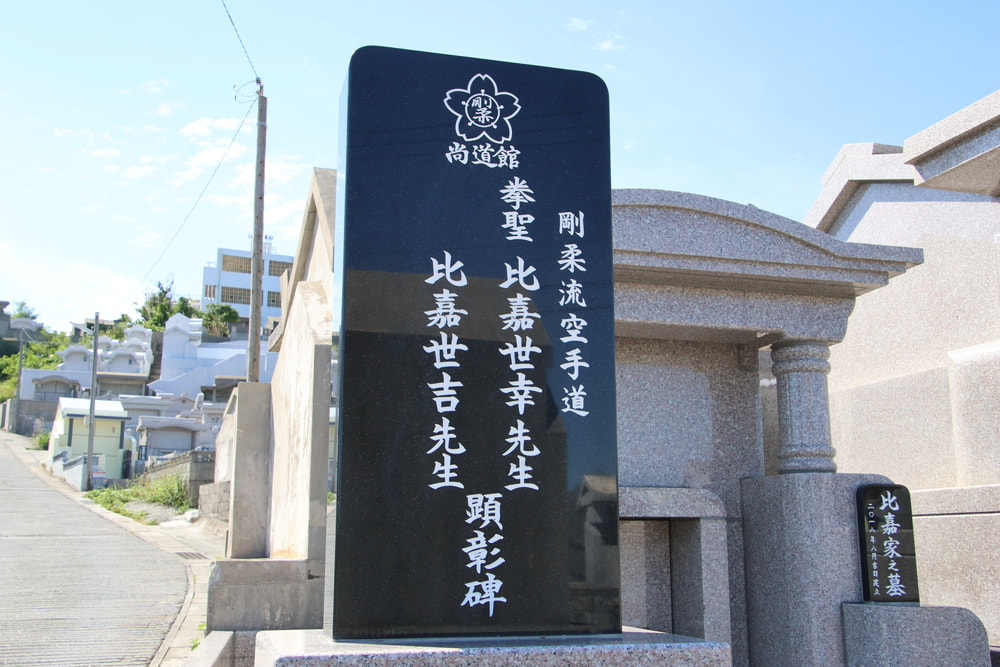
Okinawan karate is not only a martial art but also a philosophy of self-cultivation through the disciplined training of mind and body. Embodying this spirit and dedicating their lives to the development of Okinawan Goju-ryu karate were Seko Higa and Seikichi Higa. Located within a cemetery in Shikina, not far from the World Heritage site Shikinaen, this commemorative monument stands as a historic site honoring the achievements of the karate masters who devoted themselves to the spread and organization of Goju-ryu.
The very name Goju-ryu signifies the harmony of “hard” and “soft”—a principle that Seko Higa (1898–1966) pursued throughout his life. As a young man, he entered the dojo of Kanryo Higaonna and later trained under Chojun Miyagi, the founder of Goju-ryu, mastering traditional karate techniques. After serving as a police officer, he established his own dojo. His efforts extended beyond Okinawa to mainland Japan and overseas, helping to disseminate Goju-ryu widely. He served as the first chairman of the International Goju-ryu Karate Kobudo Federation and the first vice chairman of the Okinawa Prefecture Karate-do Federation. Higa was highly regarded not only for transmitting technique but also for emphasizing etiquette and spiritual discipline, and he is remembered as one of the leading instructors of Goju-ryu karate.
Carrying on his father’s aspirations was his eldest son, Seikichi Higa (1927–1999). From early childhood he trained in Goju-ryu under his father’s guidance, and as an adult he assumed leadership roles within organizations such as the International Goju-ryu Karate Kobudo Federation. He deepened exchanges with the karate community throughout Japan and abroad, devoted himself to nurturing the next generation, and left a significant legacy in the promotion and development of karate. The dedicated efforts of this father and son over two generations have contributed greatly to the flourishing of Goju-ryu today.
The Higa family gravesite, where the monument stands, features the traditional Okinawan turtleback tomb (kamekō-baka), strongly reflecting Okinawa’s unique cultural heritage. The names of the Higa father and son are engraved on the monument, quietly conveying their lives and passion for karate to all who visit.
This historic site holds special meaning for practitioners of Okinawan Goju-ryu and is also an important cultural heritage location for the karate world. More than simply a historic marker, it offers visitors a place to reflect on the historical background in which Okinawan karate was born and on its enduring spiritual values. Here, one can gain a deeper understanding of how Goju-ryu spread and developed, and of the dedication and passion of the people behind it.
The philosophy of karate embodied through the lives of the Higa father and son continues to be carried forward by many practitioners today. For those who wish to explore the origins of Okinawan karate, who are interested in Goju-ryu, or who hope to experience Okinawan culture firsthand, this is a historic site well worth visiting.