
Introducing the Tomari-te Lineage Historic Site in Katsuyama, Nago City:
**“Kosaku Matsumora Seclusion Residence Site Monument”** | Okinawa Dento Karatedo Shinkokai
Nago City
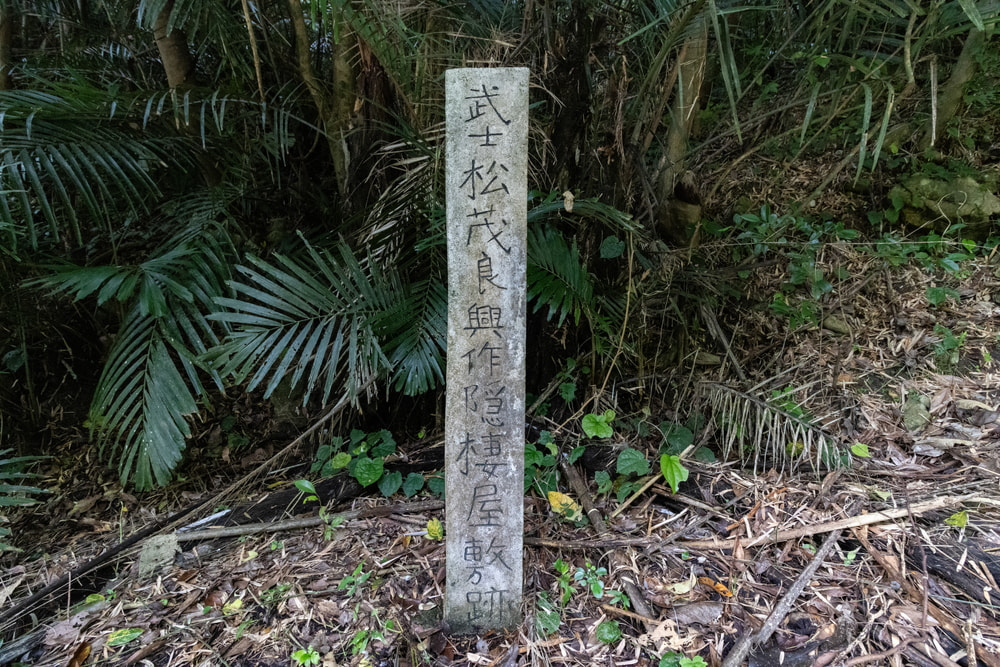
Along a quiet mountain forest road in Katsuyama, Nago City, a solitary stone monument stands unobtrusively by the roadside. Inscribed upon it are the words: “Site of the Hermitage of **Matsumora Kōsaku**.” This place marks where a man revered as the “Restorer of Tomari-te”—one of the three major lineages of Okinawan karate—once lived for a time.
Matsumora Kōsaku was born in 1829 (the 12th year of Bunsei) in Tomari Village, an area corresponding to present-day Tomari in Naha City, into a family of the shizoku (former warrior class). As a port town, Tomari was especially open to foreign cultural influences, and the young Kōsaku devoted himself there to the study of *ti* (the art now known as karate). Choosing not to serve the royal court, he lived as an independent martial artist, honing techniques that were practical and keen-edged—an approach that made him stand out even in Okinawa of his day.
In his prime, he instructed younger practitioners in and around Tomari, reviving and further developing a tradition that had begun to wane. His character, no less than his skill, attracted many people. A well-known legend recounts how, when an overbearing Satsuma retainer abused local villagers, Kōsaku confronted him alone and subdued him through martial skill. This story lives on as a testament to his belief that “the power of martial arts exists to protect others,” and he is remembered as a chivalrous figure who embodied that spirit.
Kōsaku’s teachings were passed on to individuals who would later shape the course of Okinawan karate history. **Motobu Chōki**, renowned as a symbol of practical, combat-oriented karate, learned Tomari-te techniques from this lineage. **Itosu Ankō** is also said to have been influenced by Matsumora’s ideas. Itosu later introduced karate into the school system and became one of the greatest contributors to its widespread adoption in Okinawan society. The lineage of Matsumora Kōsaku continues to form a vital pillar of Okinawan karate through schools such as Shōrin-ryū, Shōrinji-ryū, and Matsubayashi-ryū.
Seeking neither honor nor rank throughout his life, Kōsaku devoted himself quietly to the way of martial arts. He passed away in 1898 (Meiji 31) at the age of 69. The monument marking the site of his hermitage here in Katsuyama reflects his character—reserved and unadorned, far removed from any ostentatious commemoration.
When tracing the history of Okinawan karate, the name Tomari-te is mentioned alongside Shuri-te and Naha-te. That Tomari-te still lives on today is because, in this very place, one man upheld the true spirit of martial integrity. Standing before the stone monument, take a moment to reflect on the life of a warrior who journeyed from the bustling port town of Naha to the quiet stillness of Katsuyama—and on the enduring heart of Okinawan karate that he left behind.